Why Do People Die? The Real Cause of Death Even Socrates Never Knew
Why do people die? Socrates died. Nietzsche died. Every famous mind in history has died, and so the logic that “anyone who is born must die” rules this world unchallenged. But Socrates never knew the cause of death. Neither did Nietzsche. None of history’s famous minds knew why death happens. If a conclusion was reached by generalising from a result whose cause was never understood, that logic already has a hole in it.
Death is the destination that 마귀 — the spirit ruling over a world ignorant of what 하나님 truly is and what a human being truly is — deceives people into being dragged toward. It is a sickness that arises because 마귀 sits as the master ruling each person’s inner, spiritual world.
하나님, who once lived in 영생, fell because of 마귀 and now exists in human form. This is the answer to the ancient philosopher’s lament to “know thyself” — within it lies both the cause of death and the cause of 영생. And the 영육일체설, which teaches that “the body changes according to the mind,” explains the principles of both death and 영생 scientifically.
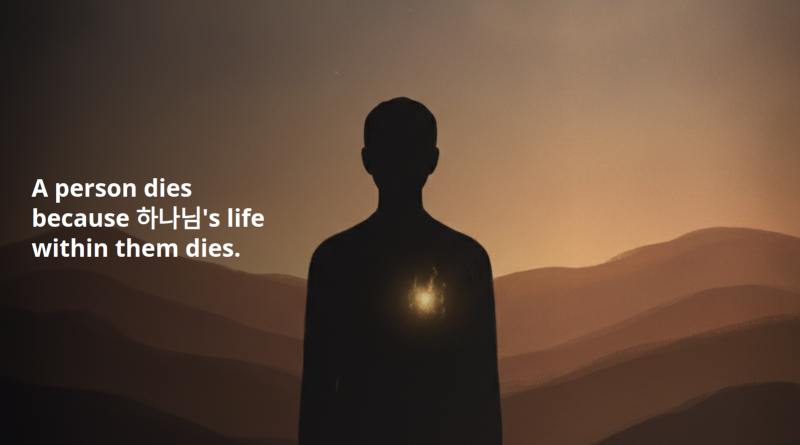
Therefore, what is called the tree of the knowledge of good and evil is the killing spirit of 마귀, and since the spirit that kills 하나님 is precisely the tree of the knowledge of good and evil, will the spirit of 마귀 that kills 하나님 kill only 하나님, or will it kill life itself, since 하나님 is life? It kills life itself, doesn’t it? So, when a person dies, it is because the 하나님 within that person dies.
The Bible, in James 1:15, already recorded desire as the cause of death — but only partially. 참성경 explains the whole of it: what desire is, why desire leads to death, and how one can be freed from desire.
Desire is what religion calls sin itself, and sin is 마귀 itself, the one who brings death. Desire itself does not indulge in desire — the ‘나’라는 주체의식 does. If desire is sin, then the ‘나’라는 주체의식 is the very root of sin: original sin, the forbidden fruit itself.
Because the ‘나’라는 주체의식 is original sin — the forbidden fruit — desire is not the only sin that brings death. Comparing, judging, worrying and fretting, liking and disliking, rejoicing and grieving, asserting pride — every spiritual activity that arises from the ‘나’ adds, in greater or lesser degree, to the accumulating cause of death.
Worry and anxiety are the spiritual activity of forcing, through desire, something to happen that desire alone cannot make happen. Stress is that same worry and anxiety with pride added on top.
The 영육일체설, taught by the 구세주, holds that blood changes according to the mind, and the body changes according to the state of the blood. That a person who looks kind is kind, and a person who looks cruel is cruel, is the result of blood — and therefore the body — changing according to however that person’s mind has habitually been set. It is scientific evidence that the body is the spirit given form.
Blood is the two-way bridge connecting 하나님‘s Spirit, the source of life, to a healthy body — spiritual activity can show up in the body, and physical conditions can affect the spirit, but, as water flows from high ground to low, the main direction runs from spiritual activity to the blood, and from the blood to the body.
The moment a person indulges in desire, 마귀 is set in motion in the spiritual world, and 피가 썩는다. Rotten blood forms clots that block blood vessels. If the blocked vessel is a small capillary feeding the digestive system, the result may be no worse than a brief, painful cramp — but if it is a vessel feeding the heart or the brain, it is fatal.
The heart that gets angry is the heart of 마귀. Therefore, people who get irritable or angry often are destined to die quickly. The reason for dying quickly is that for people who get angry often, 70% to 80% of their blood rots away, and when this rotten blood circulates through the blood vessels, it cannot circulate properly and blocks the blood vessels.
The human body is made of cells, and the cells that form bone, organs, and skin are all formed from blood. Clean, unpolluted blood forms healthy cells — but if 10% of the blood has rotted, the capacity to form cells falls by 10%; if 50% has rotted, it falls by 50%. This decline in the number of cells that make up the body is exactly what aging is.
A bigger problem than aging is when rotten blood takes part in forming the cells themselves. When rotten blood drives genetic mutation, it produces the abnormal cells, pathogens, or viruses that become fatal illness — cancer among them. A hospital can prescribe medicine to clear away the visible pathogen, virus, or cancer cell and improve the condition, but if the root cause — the rotten blood itself — is left untouched, the illness returns not long after discharge, and death follows.
I clearly said. I said that if you commit sin, you will surely die. Only those who do not commit sin do not die; if you commit sin, you die.
To say it once more: every spiritual activity that arises from a person’s ‘나’ — in greater or lesser degree — adds to the accumulating cause of death. And so, in an age when this was only partially understood, the saying “one must be born again through 성령 to be saved” meant, in the end, exactly this: “there is no salvation for those who live by feeding on the human mind.”