What Was Your Past Life? It Wasn’t Reincarnation — It Was Your Family Line
The person reading this right now is you, and this very moment you’re breathing is your present life. So what were you, before you were born into this world?
This question has become such a mysterious and fascinating subject for a reason. Before sound theology was established in this world, what spread first among people were fixed mythological notions. Theology, as the study of 하나님, is expected to be realistic, rational, and scientifically coherent, whereas myth demands no such verification — if enough people agree on it, that’s all it takes to become accepted as truth.
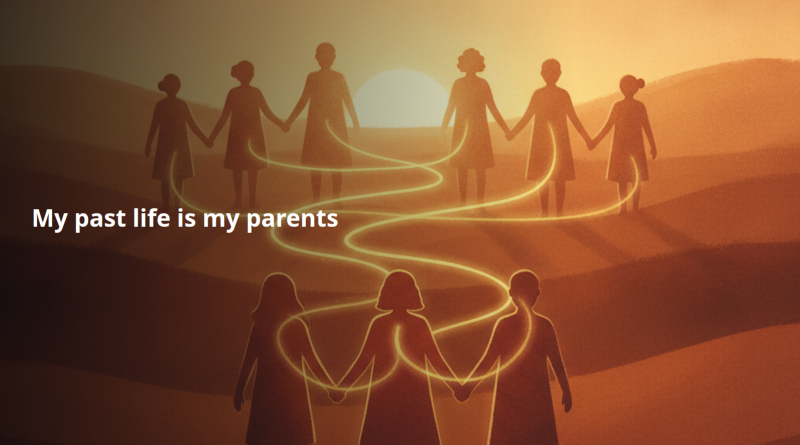
참성경‘s theology is the study of 하나님 and 마귀, of life and death. Seen through that lens, the answer turns out to be surprisingly simple. Your life being born into this world in human form is simply the continuation of your mother and father’s lives. And your parents’ lives, in turn, were continued from their own parents.
“A human’s past life is precisely this: my immediate past life is my parents. The life my parents lived is precisely my past life, and the second past life is the life of my grandfather and grandmother. … The third past life is your great-grandfather and great-grandmother. As for the fourth past life, it is your great-great-grandfather and great-great-grandmother.”
— UWS 2:4-10
In other words, your past life was your parents’ life, and your afterlife is them living on as you. A past life isn’t a single event — it’s a straight line stretching back across generations, arriving at you today.
What about the “afterlife,” then? Anyone living in this present life is, in a sense, the afterlife of ancestors whose blood they carry — and the spirits of those ancestors are still flowing in that very blood.
“Everyone, the soul of a dead person is the blood of the dead person. … So, the spirit of the dead person does not ascend to heaven; because the spirit of the dead person is the blood of the dead person, the blood of the dead person is within their children or their family.”
— UWS 1:10-16
The same principle explains why a shaman’s 굿 can seem to call back the spirit of a dead relative, and why people so often say “you look just like your mother” or “you act just like your father” — it’s the ancestral spirit still flowing in the bloodline.
In myths, multi-headed beasts can talk, think, and turn into people. Reality is different. A monkey gives birth to a monkey, an elephant to an elephant, a human to a human. Life doesn’t drift across species — it runs straight down the bloodline.
So where did the teaching of “reincarnation” or the “cycle of rebirth” come from? In a dark world without the light of truth, it was likely an expedient teaching devised by people who believed in myth, meant to urge, “don’t live wickedly in this life — live righteously.” In its own way, it did slow the speed at which the world would otherwise turn as savage as the wild. But 참성경 draws a hard line against speaking carelessly of reincarnation without even understanding what spirit or soul actually are.
“Not knowing what spirit is, nor what soul is … there are even people who speak of some kind of reincarnation theory, but it’s all utter nonsense.”
— ACT 11:57
The fact that this idea of reincarnation is taught so carelessly today, and still gains a following through plausible-sounding sermons, doesn’t even match the teaching of Buddhism’s own founder, Sakyamuni.
Sakyamuni gave up his status as crown prince and took up spiritual discipline precisely to find a way to end the suffering of birth, aging, sickness, and death. What he called nirvana or Buddhahood wasn’t — as commonly assumed — a word used for a senior monk’s death. It meant the state of having broken the cycle of birth-aging-sickness-death and rebirth — cutting off the cycle of 마귀, which brings death, and being reborn as Buddha. That state is called 탈겁중생 (脫劫重生) — escaping the kalpa and being reborn.
Yet Sakyamuni himself declared that he had not reached that state.
“In reality, Teacher Sakyamuni said, ‘I have not entered nirvana,’ ‘I have not achieved Buddhahood.’ ‘The disciple who says I have achieved Buddhahood is not my disciple.’ … After 3007 years, after this person (Sakyamuni) died, after 3007 years, it is prophesied that the 생미륵불 will appear, in the Buddhist scriptures.”
— LMB 4:8-10
In other words, Sakyamuni made clear that his own teaching was not itself the completed path to liberation, but an expedient teaching meant to guide the world well until the one who would actually break the cycle of birth-aging-sickness-death and rebirth — the 생미륵불 — appeared in a later age. By drawing the line that even a disciple who claimed he himself had achieved Buddhahood was no disciple of his, he was already foreseeing an age in which his own teaching would be twisted — an age of degenerate dharma.
Just as your past life turns out to be not some mysterious maze but your own family line, the answer to the afterlife you’ve been looking for may already be flowing in your blood — and may already be here, in this very age.