Who Does the Bible’s “Antichrist” Actually Point To?
To tell a fake from the real thing, you need a real thing to compare it to. But history often runs the other way: the fake settles in first and builds a vested position, and it’s that same early arrival — not the late one — that brands the real thing a “heretic” once it finally shows up. So who does the Bible’s “Antichrist” actually point to? The one who arrives late and disturbs the existing order — or the one who has been ruling from the start and resists once the real one appears?
Where Did 하나님‘s Spirit Go?
Christianity already knows that 하나님 who was with Abraham passed to Isaac, and 하나님 who was with Isaac passed to Jacob. But where did it go after Jacob?
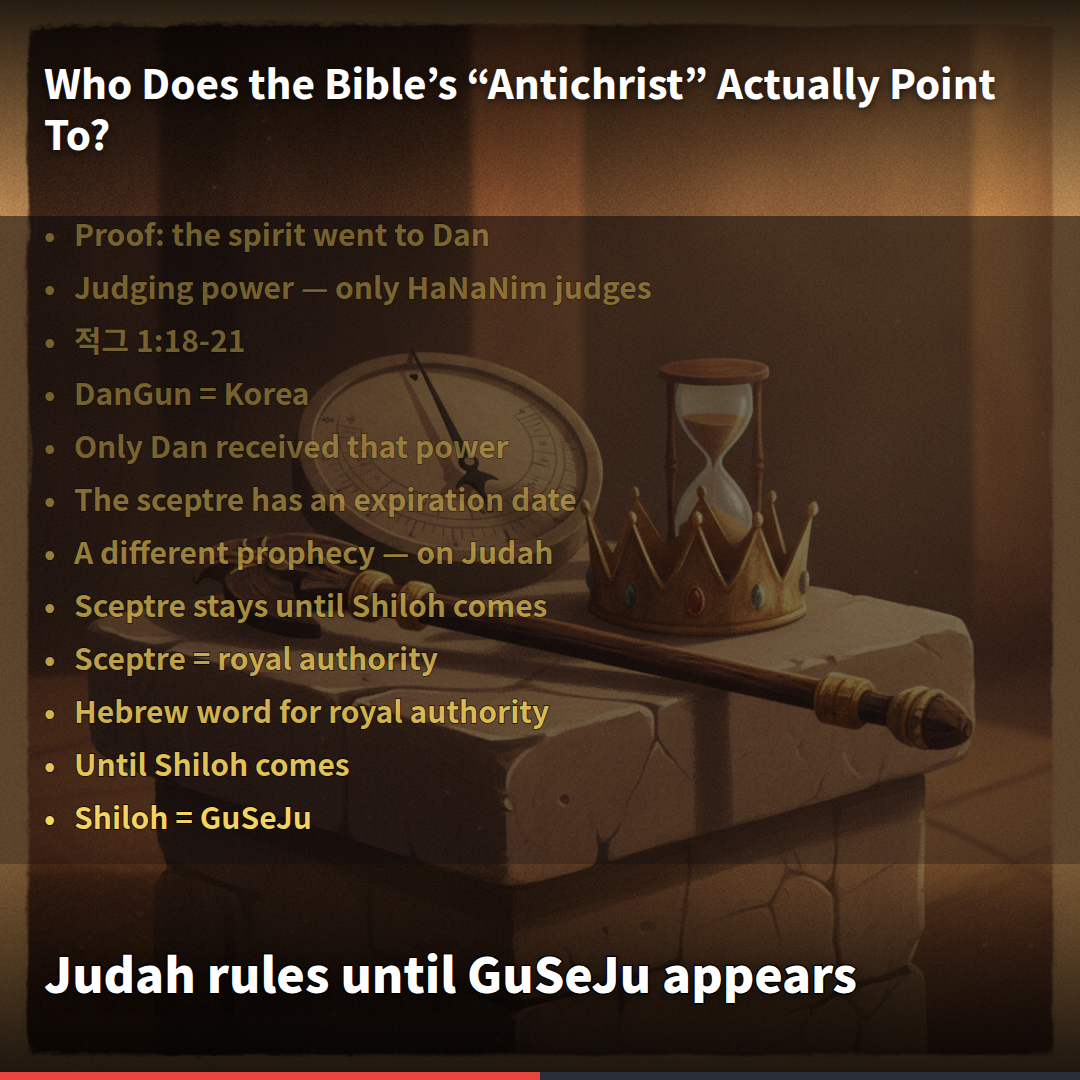
“However, the 구세주 is saying today that Jacob’s spirit of 하나님 came to 단군 할아버지, isn’t he? As recorded in Genesis 49:16, “Dan shall judge his people… Dan shall be a serpent by the way, a viper by the path, that bites the horse’s heels, so that its rider falls backward. I wait for your salvation, O Lord,” such a verse is recorded, isn’t it? What this means is, it’s proof that Jacob’s spirit of 하나님 went to Dan, isn’t it? Since Dan was given the authority to judge his people, only 하나님 can judge, a human cannot judge, can they?”
— 적그 1:18-21
Dan’s descendants added an honorific and called themselves 단군 — Korea. Christianity believes the line ran through Judah or Joseph, but of the twelve sons, Genesis 49 gives the words “he shall judge his people” to Dan alone.
The Sceptre Has an Expiration Date
Yet a few verses earlier in that same Genesis 49, there’s an entirely different prophecy — about Judah.
“However, if you look at Genesis 49:9, “Judah is a lion’s cub; the sceptre will be with him until Shiloh comes,” such a verse is written, isn’t it? So, Judah as a lion’s cub, “the sceptre will be with him” means that royal authority is with him, doesn’t it? The word ‘sceptre’ is a Hebrew word meaning royal authority. Then it said “until Shiloh comes,” and the word ‘Shiloh’ is also Hebrew, isn’t it? If you translate that, it is 구세주. So, until the 구세주 appears, Judah will rule as king with royal authority, isn’t that what it means?”
— 적그 1:24-29
Jesus is a descendant of Judah. But this very verse built an expiration date into that rule from the very start — not an eternal throne, but one held only until the 구세주 appears.
The Moment the Horse Rears
A different chapter of the same book describes the moment that expiration date runs out.
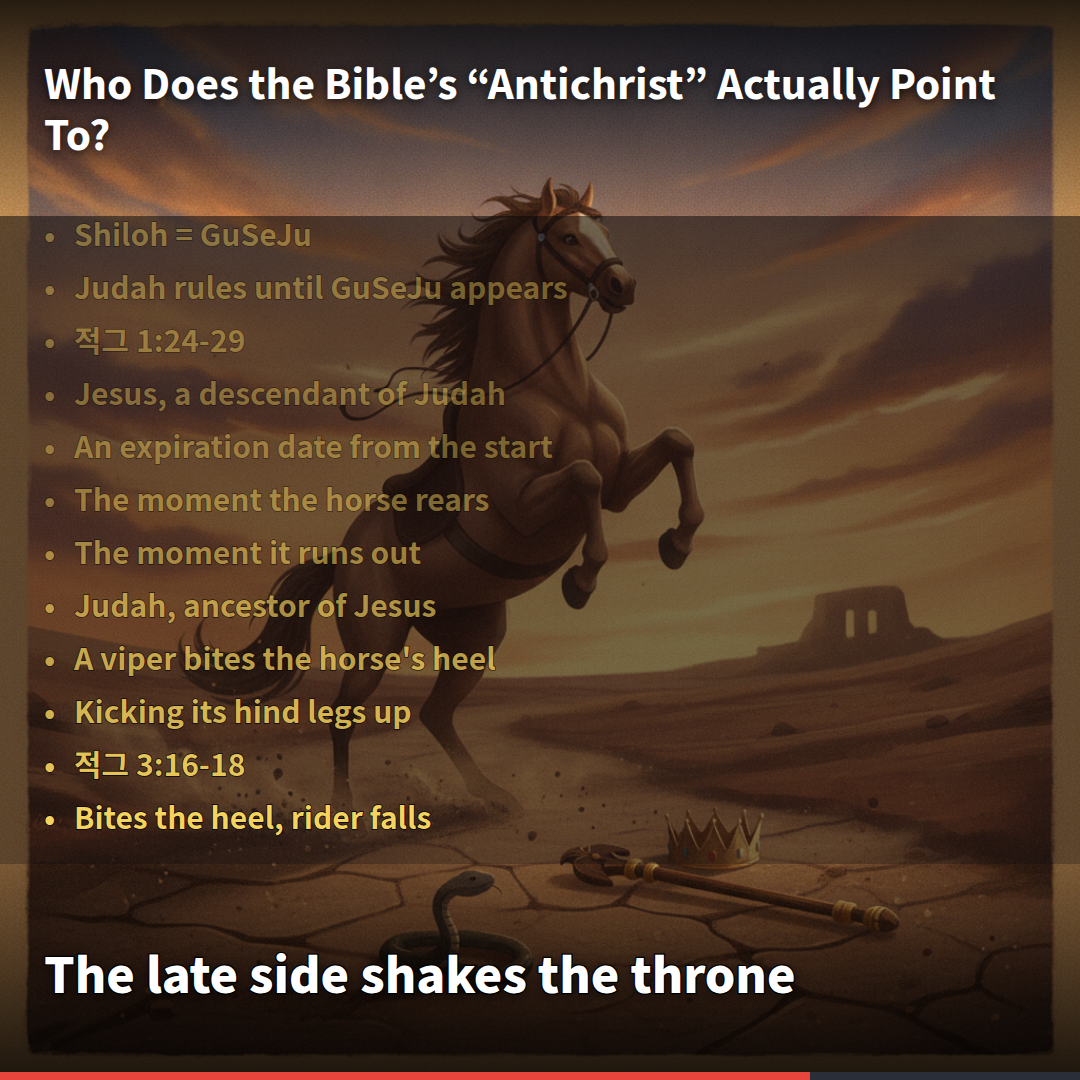
“Judah is the ancestor of Jesus, isn’t he? Jesus rules as king, but he only rules as king until the 구세주 appears; when the 구세주 appears, a viper bites the heel of the horse that Jesus, who is ruling as king, is riding, so does it sting or not? Because it stings, will (the horse) kick its hind legs up to the sky, or just a little?”
— 적그 3:16-18
The Genesis 49:16 verse quoted earlier — “bites the horse’s heels, so that its rider falls backward” — is describing exactly this moment. The side that has been ruling from the start isn’t safe forever; the instant the late-arriving side bites its heel, it shakes.
So Who Is the Antichrist?
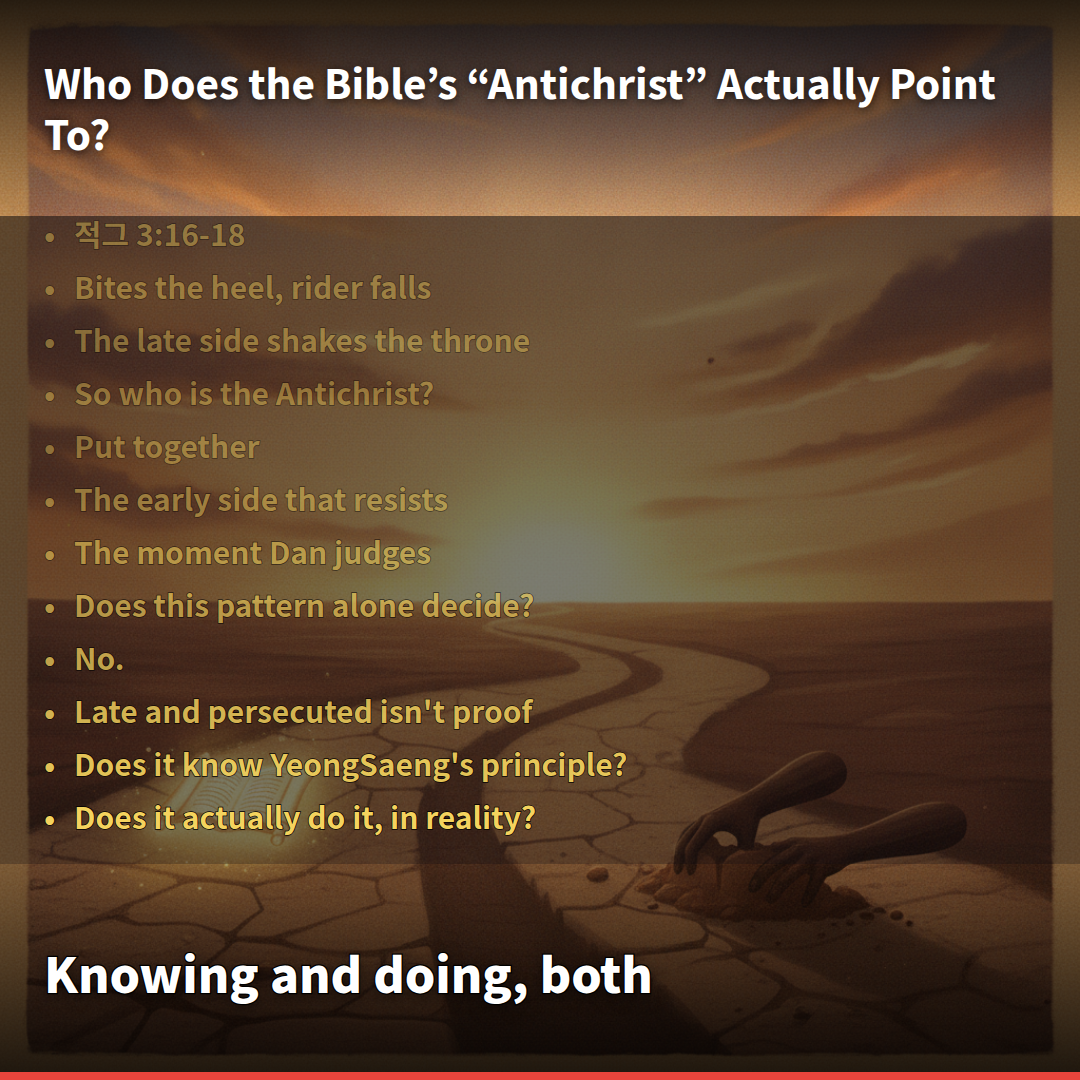
Put together, the pattern looks like this: the Antichrist isn’t the suspicious newcomer who shows up one day and causes a commotion — it’s the side that has been ruling from the start and resists once the real, late-arriving one finally appears. Holding the vested position doesn’t make it permanent, and 참성경 says the moment that reverses is exactly the moment Dan — 단군, Korea — receives the words “he shall judge his people.”
So does this pattern alone tell you which side is real? No. Arriving late and getting persecuted isn’t, by itself, proof of being the real one. In the end, the test is simple: does it know what a religion is supposed to know — the real principle of 영생? And does it actually do, in this real world, what a religion is supposed to do — or does it stop at lies and empty promises? Knowing and doing: whichever side holds up on both is the real one.