Why Was the Gyeokamyurok Called “Korea’s Nostradamus”?
Korea has had prophecy books passed down for centuries. Among them, the Jeonggamnok is the most widely known, but there is one book that even earned the nickname “Korea’s Nostradamus” — the 격암유록. Why did only this book get such a nickname?
Nam Sa-go, the Prophet of Joseon
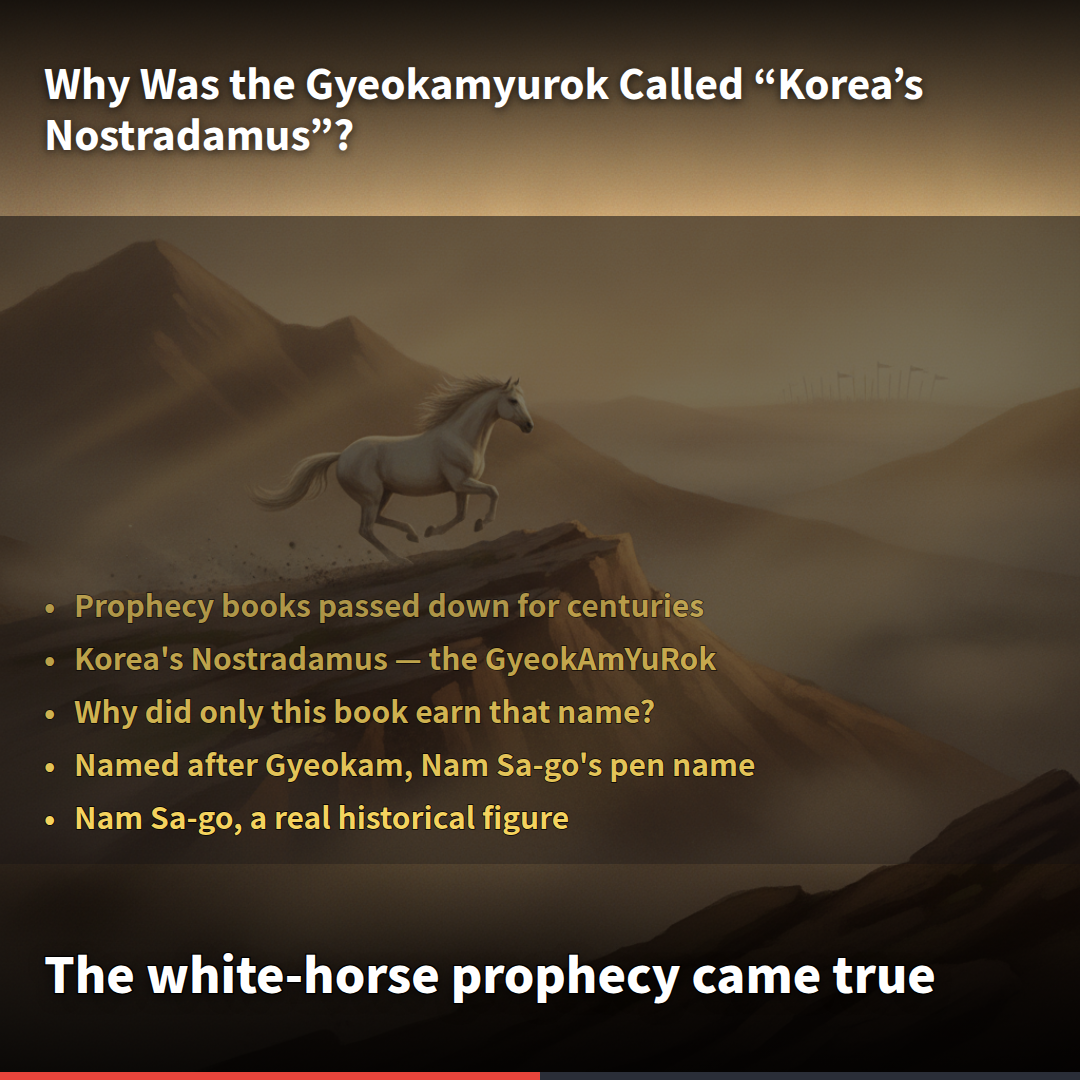
The 격암유록 is known as a prophecy book named after “Gyeokam,” the pen name of Nam Sa-go, a figure from the reign of King Myeongjong of Joseon (1509–1571). Nam Sa-go is in fact a documented historical figure. Jibongyuseol (circa 1614), written by the mid-Joseon scholar Yi Su-gwang, records an anecdote: Nam Sa-go predicted that “a man on a white horse would invade from the south in the year Imjin (1592)” — and when the Imjin War actually broke out, the Japanese vanguard general Kato Kiyomasa did in fact invade riding a white horse.
“Nam Sa-go’s Secret Record,” Which Appeared Before the Jeonggamnok
This was not the first prophecy book to carry Nam Sa-go’s name. While investigating a 1733 sedition-poster incident in Namwon, Jeolla Province, authorities discovered a document called “Nam Sa-go’s Secret Record” — a record that predates the Jeonggamnok, today’s most famous prophecy book, by a considerable margin. The tradition that “Nam Sa-go left behind prophecies” is old enough to appear even in official investigation records of the late Joseon period.
What Happened When the “격암유록” Came Out
The book circulated today under the name “격암유록” only became widely known in the mid-to-late 20th century. But once it was made public, people reacted with astonishment — it seemed to have foreknown major events of modern Korean history, from the Imjin War to the Donghak Peasant Revolution, the Japan–Korea annexation, the Korean War, the April 19 Revolution, and the May 16 coup. Phrases like “the people’s scripture that unveiled its mystery after 450 years” began to appear, and from then on the nickname “Korea’s Nostradamus” stuck.
Of course, a book that caused this much of a sensation inevitably draws just as much heated controversy. That is the “forgery controversy” surrounding the 격암유록 — and the next article takes that controversy on directly.